....the writers' strike combined with the larger economic crisis has moved much of the talk from anxiety to calamity.....Alisa touches on a couple of issues I find worth reflecting on. First, pedagogically, what adjustment should a scholar make in teaching in a pre-professional context. I teach in a production department, so I'm always wondering how much an instrumental context alters the pure scholarly pursuit of knowledge.
An initial response for some might be to say "huzzah! bye bye big media!" However, as someone soon to speak to many an undergraduate eager to make a living in a world in which downsizing and bankruptcies are the new state of being, I can only feel distressed by the emerging state of the media world.
Wednesday, December 31, 2008
Normative Analysis and Political Economy
Do Romantic Comedies Indoctrinate?
Sunday, December 28, 2008
SATC photo essay


Sex and the City as fort/da structure....
(Forgive the spoilers ahead.)
1. Wedding Dress [1]

2. Wedding Dress [2] - da/fort

3. Apartment [1] - da/fort

4. Apartment [2] - fort/da

5. New Year's Eve

6. fades

7. Auction/gift
8. Rented/real
9. Cinderella motif

Not only the photo above, but the numerous references: Louise "squeezing" into Carrie's shoes, Carrie reading Cinderella to Lily. The shoe moment, though, captures the transformation from "not" to "is."
10. Miscarriage/birth
Charlotte goes from barrenness to fertility, but fears that any moment she could lose the baby. She overcomes these fears, but it is only the birth which provides the final narrative resolution of the threat of loss.
11. Sale/nullification

Real estate is never just sold. Louise checks to see if Carrie really wants to go through with the 5th Avenue apartment sale. Carrie does not in fact go through with the sale of her former Village apartment. The only transaction that is final is the Mexico honeymoon suite, though Samantha tries to get Carrie out of that one.
Friday, December 19, 2008
The 1950s

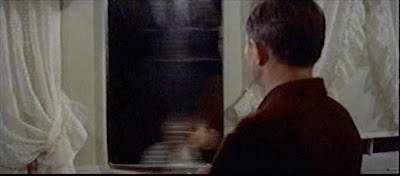
Ignore the digital interlacing blur. The above's a momentary glimpse of DP or director Nicholas Ray as James Mason shuts a bathroom mirror in Bigger Than Life (1953). It seemed a fitting metaphor to me of the thematic complexity of the film - an undercurrent that ever since the Cahiers critics has been part of the Nicholas Ray text, but still runs against an overpowering reading formation.
Namely, the historical ethnocentrism that assumes naivete in 1950s cinema. By now, there's a range of critiques we see of 1950s domestic ideologies, especially as Hollywood trafficked in them. Some of these critiques are profound, some facile, many in between. But I think we underestimate how much Hollywood offered at least some kinds of contemporary social critique. These critiques could be distinctive (the Cahiers version suggests Ray as auteur on this basis), but the auteur production was merely one form of wider grappling with social critique. There's a larger interest I have: some scholarship on American melodrama has hinted at this (Barbara Klinger, Marianne Conroy), but the popularization of sociology forms a key thematic backbone of 1950s melodrama.
Friday Giallo Blogging

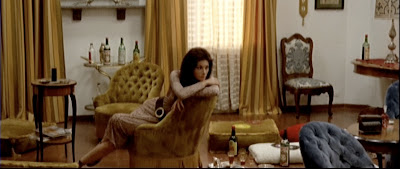
From The Strange Vice of Mrs. Wardh.
A reader helpfully points me to a discussion on J&B. Apparently the scotch maker had a product placement with Italian production companies. None of which obviates, in my eye, the ideological significance. On which I'll have more to say.
Friday, December 12, 2008
Film studies blogs A-Z
Tuesday, December 09, 2008
Springtime in the Sierras

The 1947 Project has paid dividends in making me aware of the unexpected places where a social problem mentality met more traditional genre production. But still nothing prepared me for the surprise of a Roy Rogers B film adopting a social problem approach. Well, Springtime in the Sierras (William Witney, Republic) is a typical B Western: "Western" only in the setting and iconography, not in its narrative structure; Manichaean in its characterization (the brunette vamp is over-the-top evil); and external in its action. The externality of action keeps it from being a problem film in the manner that Gentleman's Agreement or even Crossfire are.
The narrative premise is that poachers are running a racket in the small-town West and are starting to kill to protect their business. The narrative starts off as an individual narrative (Roy Rogers stumbles on a wounded animal and takes her to a local rancher) but quickly the dialogue points out that poaching is a national problem. What follows is a documentary sequence that steps back from the narrative, as a voiceover relates the problem of poaching in the U.S. It ends with a judge admonishing "the lowest form of criminal" (!) in a setup reminiscent of the 1930s Warners topicals.

The film dissolves back and the narrative continues as before. The only thing I've seen quite like it is the "beef to feed a nation" montage in Red River, which also departs from the diegesis.
Friday, December 05, 2008
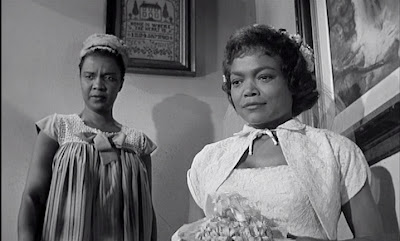
PCMS: Ellen Scott on Anna Lucasta
Ellen Scott, University of Pennsylvania
"Acting Fresh: Civil Rights, the Black cosmopolitan theatrical aesthetic, and the reception of Anna Lucasta (1959)”
Respondent: Homay King, Bryn Mawr College
Thursday, December 11, 2008, 5:30 PM
Temple University Center City
Room 420

This paper explores the cultural resonances of and patterns of identification
with the urbane black melodrama Anna Lucasta (1959), a relatively unexamined film that significantly included African American input into the processes of production and contributed to the development of an cosmopolitan black aesthetic and style of characterization for Hollywood cinema. In this paper, I use both theater and film production history and the responses of reviewers of the Black press, who linked the film to “modernity”, to tease out the meanings of Black, mid-century cinematic cosmopolitanism, its citations of the vernacular visual style of noir and its relationship to the emergence of civil rights. This paper joins with previous work that seeks to reexamine the films of the 1940s and 50s to better understand their racial meanings and continuities with Black-authored films of the 1960s and 70s.
Ellen Scott is a Mellon Post-Doctoral Fellow at the University of Pennsylvania in the Department of Cinema Studies. Her research is on the cultural meanings and reverberations of film in African American communities and her current work is on the dialogical historical intersections between Black film reception and the censorship of films with racial themes during the 1940s and 1950s. Her research and teaching interests include African American cultural history, film theory, American film history, sound theory, the history of film censorship, and cultural studies.
Homay King is Assistant Professor of History of Art at Bryn Mawr College. Her fields of speciality include American cinema, film theory, psychoanalytic theory, and feminist film theory and criticism. She received her doctorate from the Department of Rhetoric at UC Berkeley in 2002, with a dissertation entitled "Effaced Figures: Authorship and the American Cinema." She has published articles on the films of John Cassavetes (Camera Obscura 56), Valie Export (Discourse 22.2), and Michelangelo Antonioni (Fort Da 6.2), and on the photography of Jeff Wall in relation to film theory (Jeff Wall: Photographs, Verlag der Buchhandlung Walther König, 2003). Her book Lost in Translation: Orientalism, Projection, and the Enigmatic Signifier is forthcoming from Duke University Press.
The full PCMS listings can be seen at its website.
Thursday, December 04, 2008
Conference: Rethinking Sex
More information at the conference website.